Ashleigh Garrison: A Podcast for People Still 'Figuring it Out'
- Celine Castronuovo

- Aug 21, 2020
- 21 min read
In early March, 21-year-old Ashleigh Garrison thought she had the next few months all figured
out.

The English major would finish her junior year at the campus of Columbia University, and she would remain in the city pursuing her interests in journalism and media with an internship at a non-profit news organization. Weekends would be spent hanging out with friends, walking through Central Park and eating her way through her favorite restaurants.
But, a little something called "COVID-19" hit the United States.
On March 15, Columbia announced its first coronavirus case and called on students to vacate the dorms as soon as possible. Garrison returned to her hometown of Detroit and was forced to trade in-person instruction in classrooms for virtual lessons from her bedroom. The university has since announced that remote learning will continue into the fall semester.
Once the summer hit, she started her internship remotely. From March until May, with the stress of confinement and the weight of rising coronavirus cases, Garrison says she often opted for “doing nothing” in her free time.
“I literally was in my pajamas all day for many, many days,” Garrison explains. “Some days, I was just upset. I was upset about all the deaths that were happening in Michigan. I was upset about losing things. I felt like I was doing what I needed to do to take care of myself, which at the time was to rest and to watch ‘Ozark.’”
But it was also in May that Garrison participated in the Dow Jones News Fund Digital Media Training Program along with 14 other college journalists from across the country. At the week-long virtual boot camp, hosted by Arizona State University’s Cronkite School of Journalism and Mass Communication, she met Syracuse University student Amy Nakamura and Wessam Hazaymeh from Virginia Commonwealth University. After the program, Garrison enlisted their help in an idea she had for a new project— one for those living with as much uncertainty as she was amid the coronavirus pandemic.
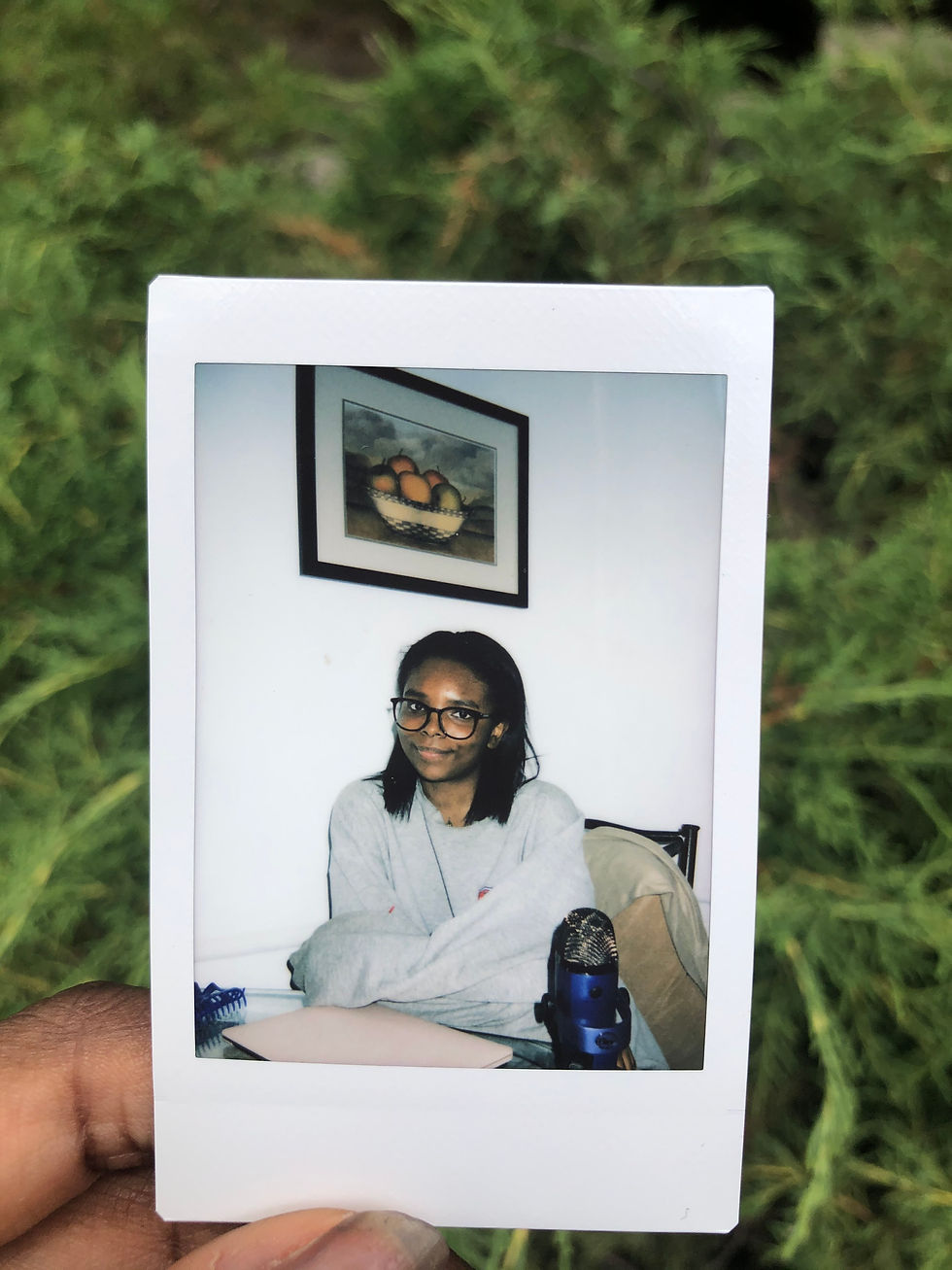
That project is now known as “Figuring It Out”– a podcast by and for young people who are facing the challenges that come with navigating the early years of adulthood. Garrison oversees production and hosts the podcast, with Nakamura editing the episodes and Hazaymeh creating the show’s promotional content on social media.
Since the end of June, Garrison has released five episodes on Spotify, with the show gaining close to 270 listens and a total of more than 400 followers on Twitter and Instagram.
In each episode, Garrison says she focuses on interviewing people who live out their passions. For instance, she has already featured a climate change activist and an internationally ranked fencer; they both also happen to be undergraduate students.
“Everyone around this age is equally as confused and just trying to make it,” Garrison says. “Even if they pretend like they have figured things out, I guarantee that they haven't.
I interviewed Garrison via Zoom to ask about her life since the pandemic began, creating her own podcast and how she, like many people her age, is still trying to figure it out.
***
The following interview was edited for clarity and brevity.
Celine Castronuovo: “How has your life been personally impacted by the pandemic? And what has it been like transitioning to this new normal?”
Ashleigh Garrison: “I honestly feel like in some ways the impact has been negative. I don't really like when people try to put a crazy positive spin on COVID and everything that's happening because I feel like inherently, some of the stuff that's going on is not great. It does suck in some ways. It's very unfortunate that people are sick. And still dying. But, I think the first few weeks of quarantine, not so much the fact that I was quarantined, but just the fact that I was not at school anymore was hard. They were really difficult also just because of the amount of news that I was consuming, and it wasn't very positive.
“But, I think now knowing that I'm going to be completely remote, it's still difficult. Even though I did have that experience in March, I think it's difficult because I had, in my mind some things that I was going to do. I guess it's like craving for memories that never happened or never will happen, memories that you planned to make. But I do think that doing meaningful things in your time is helpful.”
CC: “So, besides the podcast, what else have you been doing in your spare time?”
AG: “I had an internship this summer that just ended a couple of weeks ago. I was working for Chalkbeat, which is a nonprofit news organization that covers K-12 education in several bureaus, mainly bureaus that I would say are more low income and disproportionately black or students of color. So they're in cities like Chicago, Detroit, New York City. I was working remotely every day for eight hours and just writing about New York City Schools and all the different reopening plans that were happening, and that felt really meaningful because I don't think people realize enough how much education in school districts has been impacted by the coronavirus. And it's not just whether or not they're going back to school. There's so many other layers to it. And I think that one of the reasons why the summer wasn't so terrible for me is that every day I was doing something that felt like I was making a difference. I was interviewing teachers and principals and students and parents about all the different ways that they're being affected.”
CC: “So, moving into the podcast. Where did you get the idea to start it and how did it come about?”
AG: “I've been listening to podcasts for the past few months. I think I really got into it last September. Before that, I listened to ‘The Daily’ sporadically and, honestly, that was the only podcast I listened to. But I got into a different format, which was more of an interview-style podcast. And I really got into NPR's ‘How I Built This.’ It's all about entrepreneurs and how they built their companies and the dude that interviews them, his name is Guy. And he just interviews these people about who they are, their paths, ups and downs of running a business. And then I got into a similar podcast called ‘Friend of a Friend,’ which is similar in that she's usually interviewing entrepreneurs, but also just people doing interesting things like dancers or entertainers.
“So, I got interested in business more, and the idea of working in that space, but then I also got interested in maybe one day starting a podcast, but not necessarily with people who have made it yet, because even though I love those podcasts, I relate a lot to peers who are also in the same spot that I'm in just trying to do cool things. So yeah, I think maybe subconsciously back then I was thinking about having my own podcast, but I didn't really think about it until late May. And I had the Chalkbeat internship and then I also had this part-time gig for an Instagram influencer, where I would be running her blog, and it was unpaid. And it just didn't really make sense as I thought about it for me to do something unpaid, creating something for someone else when I could not get paid and create something for myself instead. I guess I do lose money now because I have to pay my employees, but I feel like an opportunity to create your own thing, even if it's not a money-making business, that's always much more worth it than some of these unpaid internships where you don't even know if you feel like you have an important job all the time.”
CC: “You’ve covered a wide range of topics so far from networking and finding jobs post grad, to other issues like climate change and sustainability. How do you come up with what topics you're going to cover and finding people to interview?”
AG: “I think for the topics, the biggest thing that I want to do is I want there to be a general theme to the episode, so, as you mentioned, career, work and then sustainability or climate. But, I also want the people who I'm talking to to have their own personal story, so it's not like I'm just interviewing a boring expert about climate and sustainability. To me, that wouldn’t really be worth 60 minutes of anyone's time. So, I think that identifying the topics and identifying the people kind of goes hand-in-hand. And usually what I find is that people who are passionate about something are just very interesting people. The topic or the thing that we discussed in the episode will kind of naturally be shaped. For example, for the Eco Gal, I knew that that episode would be a climate and sustainability themed episode, because that's her specialty. I want to choose topics that are informational, but not something that I feel like is going to go over anyone's head. I'm not a climate expert, so just hearing data and stats might not be the best thing for me or for other young people. So, I think we focus a lot on advice and tips and practicality. And for the fencing episode, obviously, I'm not a fencer, and most people aren't. So I thought that that was the cool thing about them, right? They're fencers. And one of them is number three in the world, which is super crazy in itself. But, I wanted to focus more on just how they became such great fencers, what their past was like and how they balance their days. How they deal with failure, things that apply to everyone.
“So, I feel like there's like three prongs and it’s identifying cool people who are interesting. But they also have to have a strong interest in a subject or something that they do that's worthwhile, and then in a way that’s relatable to everyone. I think that I want to do a wide range of topics, but in a way, it's all oriented around young adults, because we're all figuring it out. That's supposed to be the point.”

CC: “Can you take me through the timeline of producing each episode, how long it takes and the different steps you go through?”
AG: “First, I would reach out to someone a couple weeks or a week before I plan to talk to them. Then I spend multiple days thinking about interview questions. I find the interviews go better when I prepare that way, especially because I'm using the audio and it really does matter what I'm saying as well. So in theory, it would take me a few days to do the questions, and I kind of do like some light stalking. I'll see if they've been on another podcast, if they've been interviewed before. I listen to some of those. For example, for the fencing episode, I've watched some fencing videos. In the meantime, I looked at their stats and stuff, I just looked into fencing, not expecting to really become an expert, but just to become comfortable and to think of questions to ask, because the goal isn't for me to be the expert. That's how I think it's different. The goal is to get them to talk in a way that's informative.
“After that, I'll record, let's say I record on a Wednesday, and the episode is set to go out the next Wednesday, that would mean that my transcribing would need to be done by Saturday or Sunday at the absolute latest. From Wednesday to Saturday, I would work on transcribing, but then also work on thinking about what I want to keep and what I want to cut, especially if our recording was an hour and a half, that would mean that 30 minutes of it would have to be cut out. I have to think of what makes sense to keep, because you want it to be coherent in a way. So, if I asked a question that was maybe a little unrelated to the rest, I might cut that one.”
And so after I send my transcription notes to Amy, we meet usually on a Saturday or Sunday. She honestly is pretty quick at editing. I feel like she's gotten quicker as we've gone along. So, she'll usually get the rough cut back to me by Monday night. So, I listen to the rough cut all the way through, usually once, sometimes twice. And I have to write down any edits or anything that needs to be fixed. Usually, it's like something small, we just need less time between this transition or getting rid of a background noise. And so it takes me about an hour and a half to create those episode notes for her. I like to be pretty thorough with them. And I also try to get them back to her quickly so that she has enough time to make the edits. And so, by Tuesday night since the episode's going out on Wednesday, we have to have a final cut by Tuesday night. I'll listen to that, once usually, and by Tuesday night, I have to have recorded my intro and outro. So, that process is very taxing. Writing it is not taxing I would say, but recording it is because, since it's a podcast, I do feel a pressure to make things perfect. And I have unlimited tries, so why not? So I'll record it a bunch of times. I'll usually send a couple different versions of the intro to Amy to see which ones she likes best.
“And then I think recently we kind of shifted our social media plan. We used to do a lot more marketing for the episode before it came out. And then I realized that didn't really make sense because the episode wasn't even out yet so they can't even click a link and listen to it. So, now we really try to do more advertising once the episode goes out. And so that's when I will go into high gear mode, in terms of posting and in terms of tweeting. And we also started off doing one episode a week. And then I realized that we shouldn't do that, not because it was too much work for us, but I just thought that it wasn't enough time to let the episodes settle, as soon as we were releasing one, we were pushing out another one four days later, and that didn't really make sense. So now we do it about two times a month, but I'm still recording every week and Amy's still editing every week because there's still stuff to do.”
CC: “How did you go about picking the people to help you produce the podcast?”

AG: “It was honestly some type of divine fate that I even met Amy and Wessam. We don't go to the same school. I went to Syracuse for my first year of college, but I did not know Amy at that time, I had never met her. And me, Amy and Wessam, we were all in this virtual media training workshop at the very beginning of summer. At that point, my podcast was kind of in the back of my mind. I thought maybe I would do it one day, but I definitely didn't think I would do it this summer necessarily.
“And then I remember for the media project that we did, Amy did an audio story and she said that she went to Syracuse and Newhouse and was a magazine major, and I guess like subconsciously lights went off because I know that Syracuse is a good school and I know that if she's a magazine major, she knows a thing or two about telling stories and writing, usually magazine majors are very good writers. And then the audio thing, I knew if she's doing an audio story, she has to be comfortable with editing. So, that was just in the back of my mind.
And then Wessam worked on social media for the little project that we did, and she was very passionate about it and so hard working.
“I think what really attracted me to both of them was that it was clear that they were good storytellers. And it was also clear that they were good people and hardworking. And that's what really mattered. I needed some people who will be committed, because we do have deadlines that we want to meet. I think that what I got from Amy and Wessam from the beginning was ambition and motivation, and that's what attracted me to them. I think that at the end of the day, it honestly came down to the kind of people that they were because, I mean, as you can tell, it does require a lot of effort and time and communicating. And I can't communicate regularly with people who I don't like.”
CC: “So, podcasts have been growing as a news and creative medium in the past few years, and there are currently 1.5 million podcasts out on Spotify right now. What do you hope sets this podcast apart from others?”
AG: “Yeah, we talk about this literally every day. This actually stresses me out a lot. Because everyone is starting a podcast out of nowhere. People who are not necessarily even journalists want to start a podcast. People are doing it because they have things to say. And because it's fun to talk and share your thoughts with the world.
“I think our format is one thing that sets us apart. There are a lot of podcasts out there where it's just people talking about something, just two girlfriends having a conversation or just one person monologuing the entire time. And personally as a listener, that does not appeal to me. I don't think I would be intrigued enough to listen for that long unless it was like some type of news feature. For example, ‘Nice White Parents’ is one person narrating the story about New York City schools, and that is compelling, but in terms of a non-news podcast, I think that just the free-flowing talking format isn't for me. I think that other people also like to hear more of a conversational but also formalized interview between two people. I think my podcast is also informative and with each episode, no matter what, the goal that I always set for myself is that I want people to listen and take something away from it and learn from it, and not just hear my opinion on something. I'm usually interviewing someone who has a purpose, about their purpose and about how they do what they do. I also think that the mission of the podcast— figuring it out— it's very specific to a certain group of people, and it’s so relatable.”
CC: “Do you think you still would have started this podcast eventually if the pandemic wasn't happening, or do you think that the current state definitely influenced you a lot in starting this?”
AG: “I would like to think that I would have started my podcast eventually. I think it would have probably not been this summer, though, but maybe in the future. I say I would like to think that because if I really think about it realistically, I don't know that I would have just because this summer, I would have been in New York, doing my internship, probably getting off of work, coming home from the train exhausted. The last thing I would want to do is work on a podcast. And then once school starts, I think I would probably just have been intimidated by the thought of starting it in the midst of a new semester. We are now going to continue it, but I think there's a difference in continuing something that you've gained familiarity with than just starting something brand new and finding people. Then after the first semester, I definitely wouldn't have wanted to do it in my spring semester as a senior trying to find a job or just chill out a little bit.
“So, I do think that this situation definitely made it possible. I don't even know if I would have done that media training program if it wasn't for COVID. And if I had not done that program, I would not have a podcast, because I can't do it all. As much as I would want to be able to edit my own audio and create the social media graphics and think about a strategy, I couldn't do it. And if I did, I'd be rolling out about one episode every six weeks, because I'm very slow at editing. I'm just not that familiar with it. So, I wouldn't have been able to do it without Amy and Wessam.
“I also think that the way that I approach my days now is different. Not to be dramatic, but I'm just so grateful to be alive. Because, honestly, you just never know with this current situation. So, I've tried to really do something purposeful each day. Even if that means just reading or something like that. And I guess the way that I view time is a little bit different now. But I guess burnout has definitely been a bit of a challenge these past two weeks, but Amy and Wessam are both very encouraging in terms of telling me to stop working and take a break, so that is helpful.”
CC: “What would you say has been your most memorable moment so far while making the podcast?”

AG: “Episode Two, the one with the two fencers. Absolutely hilarious. I was initially so nervous to do the fencing episode because I kept wondering if people besides Amy and I would find fencing interesting. But Amy really is helpful, because she kept saying like, 'no, I think it's interesting, I think it can be good. And then from there, I shaped the interview to be more about their journeys as opposed to the technicalities of fencing, because most people aren't interested in that, but they're interested in knowing how someone became like a ranked athlete or something and how they balance regular college work with training. There are a lot of college athletes out there who I think would find the episode useful, whether or not they fence.
“But that episode was so fun. The fencers, Julian and Sidarth, I used to be their RA, but I didn't talk to them a lot before we recorded, so it was just interesting talking to people I honestly had always wanted to have full conversations with, but just never had the time. So, I finally got to talk to two people who are my age and were my residents and are just very impressive people and very hardworking and very funny.
“The most memorable moment was during the episode. Sid [Sidarth] starts telling this story about being at a fencing match with Julian. Julian was fencing and Sid was on the sidelines with his friends. Sid was goofing off with this friend, making fun of Julian a little bit, and then he says that he heard a blade snap. So, Sid's telling the story to me on the podcast. I was like, a blade snaps, what does that mean? And then he said that he turned around and he saw Julian gripping his hand and turning to the side a little bit, and screaming. And Sid said that after he saw that he turned his friend and was like, ‘oh, Julian got hit by like a blade and he's being a baby about it.’ And then he said that, as he looked closer, he noticed that everyone in the room had stopped and was looking at Julian. So Sid looked and saw that a blade was literally through Julian's hand.
“And so I'm hearing this story and I'm like, how have I known Julian all this time and I never would have known that a blade went through his hand at a fencing match. It was just so funny the way that Sid was telling it, and then he said that Julian basically went to the hospital and Sid did this really funny Snapchat of the X-ray of the blade through his hand. His hand is fine now, he just has a scar. But then when Sid got back to campus, he was so popular because he had posted Julian's X-ray on his Snapchat story, and everyone on campus was coming up to him asking him about it.”
CC: “What has it been like for you personally to watch this podcast grow and evolve and come to fruition since you launched the first episode in June?”
AG: “It's been very crazy and gratifying, just because I had been listening to podcasts and I was completely obsessed with them. I would listen to ‘How I Built This’ every day on the way to campus and it's crazy hearing myself in that format, because I never really imagined myself as someone who would do a podcast. As a journalist, I think I previously tried to do everything possible to minimize my personal presence on social media and make it just very much about journalism work, unbiased. But that's not life. That's what I realized, since everything that's happened, that type of objectivity is kind of silly. And I think it's better to be able to show your personality in some ways.
“I’ve also really enjoyed just being able to see when people message me things like, ‘I really enjoyed this episode’ or ‘that was really helpful, or ‘I love the podcast. People will message me, sometimes people who I don't even talk to on a regular basis or haven't talked to in years from high school. And that means a lot to me. There have been a few people that have been constantly telling me, ‘I'm so proud of you.’ And that means a lot to me.
“I think it's also been really gratifying to see how Wessam and Amy are developing and have developed. I do think that even though they were great to begin with, I think there's just a greater sense of comfort, probably because we know each other, but I also feel like they really, really, really know what they're doing. And I think as the podcast has developed the mission and the goal of it has become clearer, I think with each episode we kind of know what we want more and like what we want to do and how we have to do it, whereas in the beginning we were trying to develop that. And so I think like in terms of starting any project, I really encourage people to just start because you can have all of these tips and tricks and things that you want to do but until you do it you can't really have a way to assess yourself or know how to improve because you have nothing to base it off of. If you want to start a podcast, just having one episode will really help you, because you'll have something to go off of, you'll have heard it, you'll know how the first one went, you'll be able to identify your strengths and weaknesses, you'll be able to find out what you liked about it, what you didn't like about it, how you can make things better for the next time. So, that's why I feel like constantly pushing out episodes really has helped us.”
CC: “Do you think even when the pandemic ends, you'd want to continue working on the podcast?
AG: “In the beginning, I think that the way I sold it to Amy was, ‘will you edit my podcast? It's just a summer project.’ Because it kind of was just supposed to be a summer project for myself. I wasn't intending to make it long term, but I think it doesn't really make sense to stop now. I feel like now is when things are getting so interesting. I'm going back to school and there are still so many stories to tell and so much to figure out. Even just being a senior, I feel like there's so much to talk about. There are all the decisions that you have to make, such as gap year, no gap year; remote learning, no remote learning? There's a lot to figure out, so why should we stop now?
I think that financially, I can sustain us until December and then we will see what happens from there. I've been saving pretty intensely because I think I knew after a few episodes that I would maybe want to continue and paying my employees is very important to me. The whole reason we have the podcast is because I quit my unpaid internship, so why would I make someone else work for me for free or even ask them to do that? And it's not like I have a bunch of money, it's just using money that I have from my internship to pay them, but I think it's important because I know what it's like to be young and in college, oftentimes you can't afford to do things for free, Even if it's just dinner money or something, it makes a big difference. So, that's why from the jump, I decided to formally hire people as opposed to just asking them to help me out. I also feel like there's a different level of commitment if you are earning money for something, that's just what I've learned from the way that I work in my own life. If I'm being paid to write a story, maybe I'm going to put more effort into it, or maybe it's gonna matter to me more.”
CC: “I wanted to start this profile series to highlight young people doing interesting things during the pandemic. With all these young people creating in this chaotic time, what do you think that says about this generation of young people?”
AG: “Young people have a lot to say, not just in a shallow way of, ‘we just have opinions on things.'

No; young people are change makers. That is what I have learned about my own generation, and even some people who are younger. Even some high school and middle school kids, when something in the world doesn't sit right with them or us, I find that we are very quick to respond and say something about it and try to do something about it. And I think that this really is no exception. I think that young people have their worlds disrupted in a way that adults may understand or may not understand. It might seem like, ‘oh, you just you don't go to school anymore. Why is it a big deal?’ But for a lot of people, it was a big deal to lose their prom or their graduation.
“And some people responded to it by choosing to do nothing, which is also valid. I did nothing for a large part of quarantine. I also want to say that there's this pressure to create these projects. But my project didn't start until June. From March until June, I was doing the bare minimum. And it's okay if you didn't do anything because, I mean, I almost didn't. And I was fine with that at the time.
“But as I was saying, I think that the way that many young people responded to grieving and losing things, was to put the power back in their hands by creating something. I've seen a lot of podcasts being made, but also a lot of artists who are producing more of their own music now, or writers who are writing poetry and just posting it online. I just feel like whatever you do is valid. You also don't have to share your project in order for it to still be a meaningful project. Even if I record these podcast episodes, and never posted them anywhere, I would still have a podcast in my eyes. And that's what I think also needs to be said. Even if I didn't have an Instagram for it, and no one saw the graphics, I would still have a podcast, and the work that we did would still be the same. And the lessons that we learned would still be the same.
“I think overall this project has made me more comfortable and also more appreciative of collaboration. I think that working with people previously would give me some anxiety. Honestly, the best part about the podcast is working with Amy and Wessam and just laughing it up in the FIO group chat and making fun of ourselves and creating memes. And I think that the reason that I've found so much joy in it is that it is outside of my comfort zone. And so, it's okay to do something that's uncomfortable. It might not always feel uncomfortable, and you might actually find a lot of joy in it.”
***

Comments